


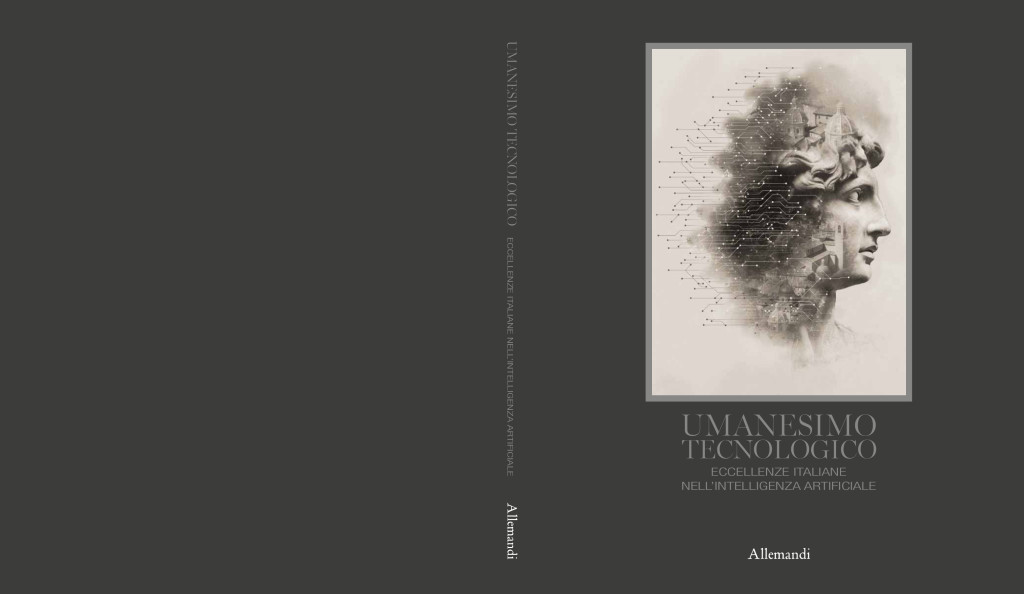
The volume published by Italy’s Ministry of Foreign Affairs, with scientific editorial oversight by AIRI, features a contribution by President Marco Conti on the FAIR ecosystem and showcases 84 Italian AI initiatives.
Building a stable ecosystem that connects research, businesses and expertise to develop trustworthy, human-centred artificial intelligence. This is the journey described by Marco Conti, President of the FAIR Foundation, in his contribution to the opening section of “Umanesimo Tecnologico. Le eccellenze italiane nell’Intelligenza Artificiale” (“Technological Humanism. Italian Excellence in Artificial Intelligence”).
Produced by the Ministry of Foreign Affairs and International Cooperation, with scientific editorial oversight by AIRI – the Italian Association for Industrial Research, the book was presented on 30 September in L’Aquila, during the 78th edition of the Prix Italia. It showcases 84 initiatives involving businesses, startups, universities, research centres and national innovation hubs.
A public-private ecosystem for trustworthy AI
In the chapter dedicated to FAIR, Conti traces the development of the national ecosystem established under Italy’s National Recovery and Resilience Plan (NRRP/PNRR) and coordinated by the National Research Council (CNR). Through cascade funding calls, the network expanded from its initial 25 partners to 136 organisations across 16 regions: 53 universities and research organisations and 83 businesses, approximately 70% of which are small and medium-sized enterprises.
At the heart of the scientific programme is AI that can interact with people, operate in dynamic environments, recognise its own limitations and take its social and environmental impact into account. This vision guides research into the foundations of machine learning, language and multimodal models, robotics and distributed systems, integrating ethical, legal and sustainability considerations.
Robustness, reliability and transparency are prerequisites for deploying AI in critical domains, from healthcare to infrastructure. Technology transfer connects these requirements with the practical needs of businesses and society.
From scientific expertise to applications
The contribution describes two complementary pathways: innovation projects led by major industrial partners and funding calls targeting businesses, with a particular focus on SMEs.
The applications developed include tools to optimise operating rooms and logistics routes, predictive maintenance systems, assistants for emergency responders and solutions supporting people with visual impairments. These initiatives demonstrate how research can translate into safer, more efficient and more inclusive products, services and processes.
“FAIR’s most important contribution lies in establishing a stable public-private collaborative ecosystem rooted in research quality to render artificial intelligence-driven innovation trustworthy,” writes Marco Conti, President of the FAIR Foundation, in the volume.
Bringing Italian research to an international audience
The book presents these initiatives across 11 sectors, from shipbuilding to healthcare, automotive, agri-food and energy. Its reference to Italian Humanism puts forward a vision of technology that enhances people’s capabilities and knowledge.
Conceived as a tool for “growth diplomacy”, the volume will be distributed through Embassies, Consulates and Italian Cultural Institutes. An international launch is also planned at the Guadalajara International Book Fair, where Italy will be the Guest of Honour in 2026.
In Conti’s contribution, this international dimension is integral to FAIR’s future: strengthening Italy’s presence in global AI research and providing businesses with trustworthy, sustainable and competitive technologies.