


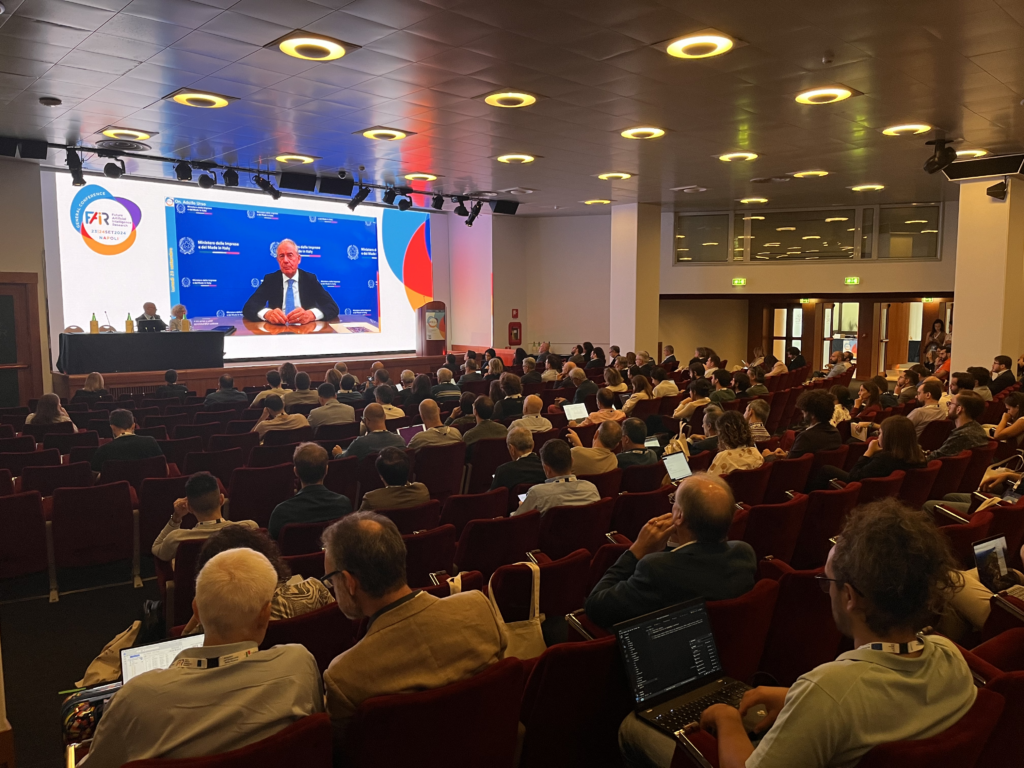
The first General Conference of FAIR – Future AI Research took place on Monday 23 and Tuesday 24 in Naples. At the midpoint of its three-year journey, FAIR brought together its research community for a scientific and dissemination event aimed at sharing the partnership’s research results with civil society, businesses, professionals, and students.
On Monday morning, the conference opened on the stage of the Royal Hotel Continental in Naples, the event venue, with institutional greetings from the Minister of Enterprises and Made in Italy, Adolfo Urso (via video message), and Prof. Maria Chiara Carrozza, President of the CNR. This was followed by remarks from Giuseppe De Pietro, President of FAIR, and Marta Rapallini, FAIR Program Manager, who commented on the results from the project’s first 18 months.
Giuseppe De Pietro interviewed by ANSA about the event and its objectives:
This was followed by the start of the scientific conference itself, structured into multiple sessions over the two days, with in-depth discussions on FAIR’s research topics: from multimodal AI to computer vision and large language models, from machine learning to human-hybrid AI, without overlooking regulatory aspects. A dedicated session on the AI Act also featured MEP Brando Benifei, who contributed to drafting the European AI legislation.
To explore the scientific presentations from the conference click here.
On Monday afternoon at 5 PM, the focus shifted to public outreach with “Next Generation AI – Italian Research for Artificial Intelligence”, a talk show organized by FAIR in collaboration with ANSA’s AI Observatory and hosted by journalist Alessio Jacona. On stage, FAIR researchers, partner companies, and distinguished guests such as Undersecretary for Publishing Alberto Barachini and ANSA CEO Stefano De Alessandri discussed the present and future of the “Italian approach” to AI.<
Topics included the challenges of AI in publishing—particularly large language models with Roberto Navigli (Spoke 5)—and the impact of AI on society and gender bias, explored by Michela Milano (Spoke 8 Coordinator). The role of AI in healthcare was also highlighted, with contributions on neurodegenerative disease research by Paolo Avesani (Spoke 2) and Giovanna Castellano (Spoke 6). Other highlights included “My Learning Talk,” an AI-based support project for university students developed within FAIR by the Politecnico di Milano and presented by Nicola Gatti (Spoke 4 Coordinator), as well as insights into the future of AI from partner companies such as Bracco Imaging, Lutech, Leonardo SpA, Intesa Sanpaolo, and Deloitte. The session was opened by FAIR President Giuseppe De Pietro and Scientific Committee President Marco Conti.
FAIR in numbers – In its first 18 months, FAIR expanded its initial core group of 350 researchers by adding 341 new recruits, reaching a total of nearly 700 participants, with 40% based in Southern Italy. Among the new recruits, 176 are fixed-term researchers, 75 are PhD students in the National PhD in AI program, 62 are research fellows, and 28 are technologists and scholarship holders.
Out of the €116 million PNRR funding, in addition to the allocations for the Spokes’ scientific activities, FAIR has distributed €29.9 million, including €18 million through 10 calls for universities and research institutions and €11.9 million through 10 calls for companies, still in the final allocation phase.
Here is the interview with Marta Rapallini for ANSA on the project’s figures: