


Here is the English translation: —
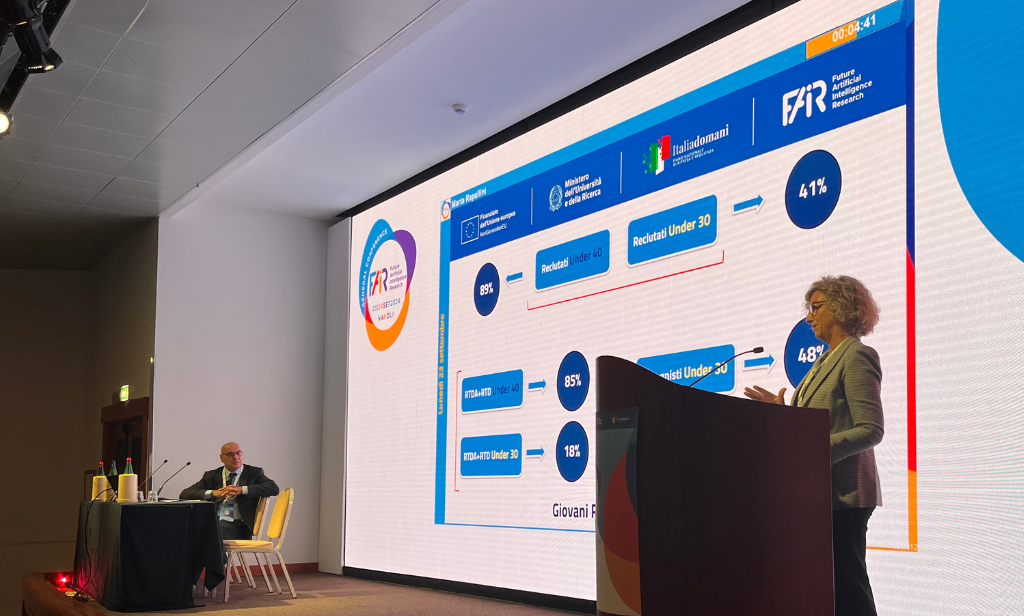
As part of the FAIR General Conference held on September 23–24 in Naples, Marta Rapallini, FAIR Program Manager, presented data outlining the results and progress achieved by the project in its first 18 months.
FAIR is structured through a modular and coordinated approach involving the Hub (the FAIR Foundation), 10 thematic Spokes, and 15 Affiliates. The extended partnership includes twelve public entities supervised by the Italian Ministry of University and Research (MUR), six additional public/private universities and research institutions, and seven companies, strengthening the connection between Italian scientific research and industry.
Personnel and New Recruitment
The FAIR research network initially included 350 researchers as its core group, joined by 55 additional research staff from partner companies and 341 newly recruited personnel, bringing the total to nearly double the initial capacity, for a total of 746 researchers.
Considering the 341 newly recruited staff members, all partners contributed to recruitment: approximately 40% of hires were made in Southern Italy, in line with PNRR requirements and project objectives.
The distribution across roles is as follows:
- about 52% are fixed-term researchers (RTDA at universities or RTD at research institutions);
- about 22% are PhD students;
- about 18% are research fellows;
- about 8% are technologists and scholarship holders.
Generational Balance
One of FAIR’s main goals is to encourage the participation of young researchers. Currently, 90% of recruits are under 40 and around 40% are under 30.
Among fixed-term researchers in the FAIR Extended Partnership, 85% are under 40 and 18% are under 30. Overall, about two-thirds of fixed-term researchers are between 30 and 40 years old.
This approach aims not only to secure the future of AI research in Italy, but also to create an inclusive environment that gives voice to different generations.
Gender Balance
Gender balance is a key cross-cutting principle of the PNRR. For extended partnerships, at least 40% of recruited researchers should be women—an ambitious target in the ICT sector, where female students represent only 14% of the total (57% across all disciplines and 37% in STEM fields).
In FAIR, women represent 25% of the core workforce and 26% of newly recruited staff. Further analysis shows that the percentage of female winners in recruitment processes matches the percentage of female applicants: men and women had equal chances of success, confirming fair selection practices.
FAIR has also implemented concrete actions to promote greater gender equality within the team, a goal that will continue in the coming years.
Cascade Calls: Funding for Research and Development
Between late 2023 and the first eight months of 2024, FAIR launched 20 cascade calls through its Spokes to strengthen AI research capacity and support innovative startups and spin-offs.
The calls are divided as follows:
– 10 calls for basic research, aimed at universities and public/private research institutions, with a total budget of €18 million. Nine out of ten calls have already produced final rankings, with 33 winners.
– 10 calls for companies, with a total budget of approximately €11.9 million, currently (as of September 25, 2024) in the final evaluation phase.
Budget, Project Expenditure and Reporting
The FAIR budget is allocated as follows: 64% to scientific partners, 26% to cascade calls, and 10% to coordination and support activities. With 45% of the total budget already spent (as of September 25, 2024), the project is on track with its financial schedule and has received positive evaluations for its scientific outcomes.
FAIR has produced 5 scientific reports, all receiving fully positive evaluations from the ETS, and 16 financial reports. Through its events and monthly newsletter, the project has engaged a stakeholder community of around 500 companies.
The figures presented in Naples by Marta Rapallini highlight an active partnership where all members are fully engaged, delivering scientifically strong results while maintaining appropriate spending levels.
FAIR in numbers – download the presentation here.